 SuperQode
THE HARNESS INTEROPERABILITY LAYER
HARNESSLAYERfor coding agents
Discover, build, run, evaluate and optimize coding-agent harnesses.Interoperable across ACP, A2A, MCP and UHP.Make smarter decisions with the Jev-powered SystemOne Harness.
Public beta · Apple Silicon · macOS 14+
Coding agents do not talk to each other. Yours will.
CodeGem for Gemini and Gemma
Six coding tools, Gemini 4 Argon and local EmbeddingGemma search
SuperQode for macOS
The harness layer for coding agents. Open a project and start building.
SuperQode for macOS
Latest public beta · Pro preview and project-opening fix
The harness layer
for coding agents.
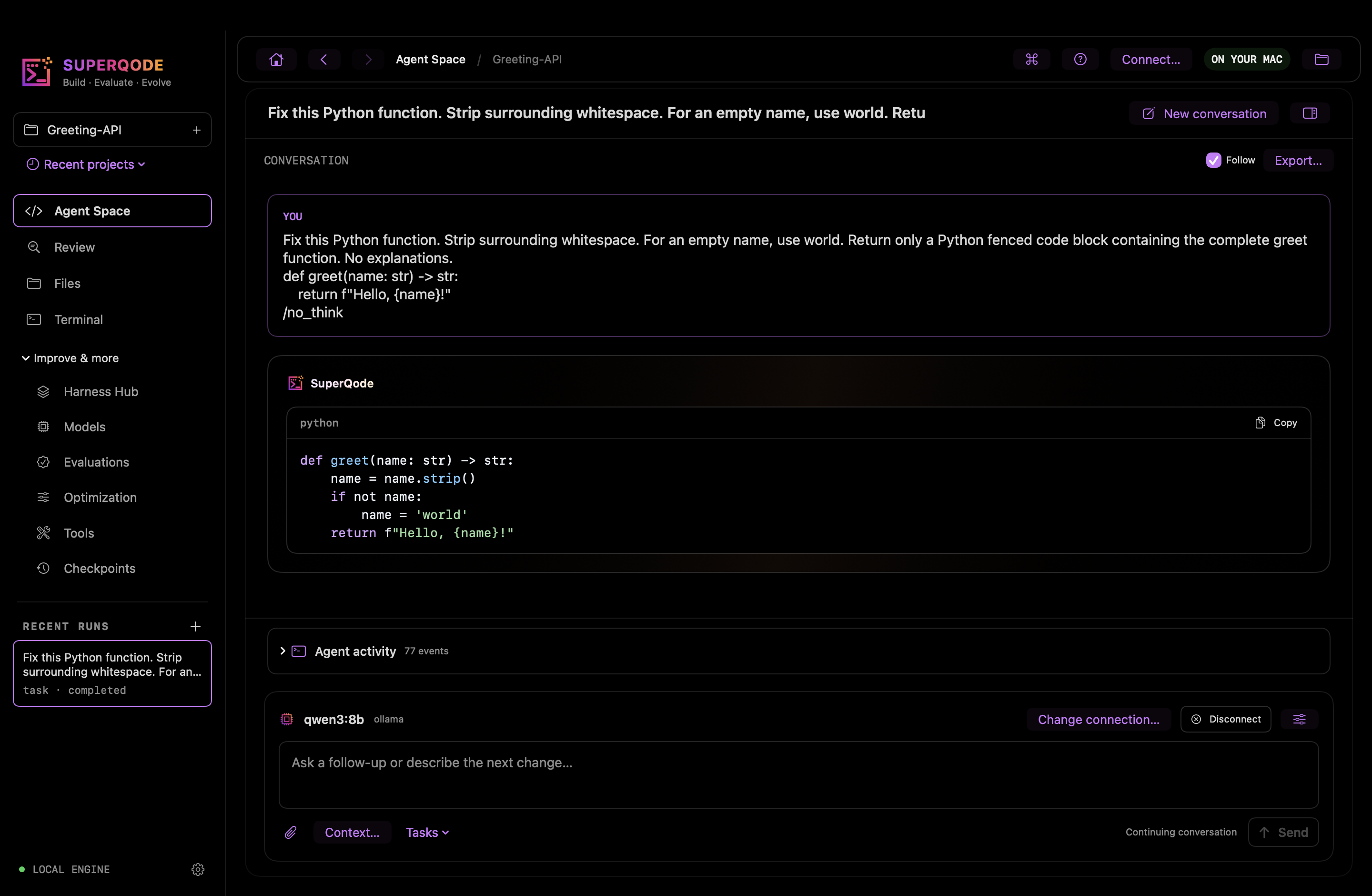
Code with your agents, review changes, explore Harness Hub, and bring evaluation and optimization into a native Mac workspace.
Switch agents within the same conversation, read formatted responses and syntax-coloured code, and follow live agent activity while you work.
Build and improve your harness
- Evaluate with evidence. Diagnose suites, select evaluation splits and inspect held-out baseline and candidate results.
- Compare and review. Explore candidate differences, grading reasons, regressions and project experiment history.
- Tune routing with your judgment. Label examples, save rationales and resume guided experiments with uncertainty and audit samples.
- Try it without credentials. Run setup checks and offline tuning practice before connecting a model.
Live experiments require a configured provider and explicit consent. Review evidence before accepting a candidate; acceptance does not automatically activate your project harness.
Read the release notesNew in macOS 0.2.1
Settings now includes a Pro preview with the planned release-confidence workflow and an explicitly fictional hold-for-review example. Opening a project from Welcome now enters its workspace while preserving saved tabs and drafts.
Pro verification, quality-record inspection, licensing and team approval controls are not available in this build. The bundled Python engine remains 2.30.0; no separate Python installation is needed.
Explore a paid design-partner pilotApple Silicon · macOS 14+ · Signed · Notarized by Apple · Direct download
This is a website download, not a Mac App Store release. Your project stays on your Mac. Requests go to the agent or provider you choose. No SuperQode account is required; provider subscriptions and usage charges may apply.
From download to your first change
Install
Open the DMG, drag SuperQode to Applications, then launch it from Applications.
Connect
Open a project and connect an existing coding agent, model provider or supported local model.
Start coding
Describe a small change, review permissions and inspect the diff before keeping it.
Beta details & download integrity
This beta supports Apple Silicon Macs. Some integrations and advanced workflows are experimental, and full terminal feature parity is not included. Updates are manual: quit the app and replace it with a newer download.
Agents and terminal commands run with your Mac user's access. Use a backed-up project and review commands and changes. The app is not an operating-system sandbox.
Report a beta issue. Remove keys and private project content before sharing logs.
Download SHA-256 checksumUse the linked checksum file to verify the latest installer.
DEMO
Watch the demo
The terminal, the Hub and the A2A agent, end to end.
One session: connect an agent, browse the Hub, and call the A2A agent from the same terminal.
Watch on YouTube →CODEGEM
Built for Gemini.
Run Gemma locally.
CodeGem is our native Python coding harness for Google's model families. Connect Gemini with your Google API key, including Gemini 4 Argon where your account has access, or run local Gemma through Ollama, LM Studio and llama.cpp. Inspect the project, make focused changes and run its tests.
Optional local EmbeddingGemma search finds source by meaning. Resumable sessions, bounded local context budgets and terminal cancellation keep the workflow usable as tasks grow.
CodeGem now supports Harness² task refinement (experimental). Watch the demo ↗
YOUR FIRST CODEGEM TASK
Find the defect. Preserve the tests.
Ask CodeGem to locate the implementation, inspect the failing test, make a focused edit and run the project checks. Review the diff alongside the test result.
- 01Find the relevant code with search and read.
- 02Apply a precise change with edit or write.
- 03Run the checks with Python or Bash.
OPEN CODEGEM IN THE TERMINAL
:connect harness-codegemChoose Local for Gemma or BYOK for Gemini. CodeGem sits beside Core, RLM, PiPy, Workbench and SystemOne.
Tools use the host process's permissions. The CodeGem guide explains its execution boundary and supported image routes.
Native Gemini history
Preserve signed response parts and tool-call identities across coding turns and disk resume.
Local Gemma budgets
Default to at most 32K context tokens, with output and compaction budgets that scale to the model.
EmbeddingGemma retrieval
Git-aware local search with source references and embedding inference outside the terminal event loop.
Harness² refinement (experimental)
CodeGem refines its own task instructions with Google Research's Propose, Probe, Compose method, then applies the patch only after your checks pass. Blog post ↗ Docs ↗
SYSTEMONE HARNESS · TUNE
Smart decisions with Jev, taught from your examples
Coding models keep writing code. SystemOne handles bounded judgments with Jev. Tune starts from unlabeled examples, asks for human review where it matters, and stages an experimental decision pack without changing your active harness.
Jev Integration ↗
Connect Jev inside the SystemOne harness. Coding models keep writing code; Jev answers Choice, Score and Noul questions that policy can inspect.
Progressive tool discovery ↗
Catalogue, search, rank, then let Jev activate a schema. Optional tools stay out of every prompt until selected.
SystemOne Tune (GEPA) ↗
Start from an unlabeled pool. Jev ranks uncertain examples, you review a small batch, and Tune stages an experimental pack without changing the active harness.
Docs: Integration · Discovery · Tune. Live Jev calls need TYPESAFE_API_KEY.
LIVE · JEV TOOL ROUTING
Send the model the tools this turn needs
Jev scores a closed set of tool choices once per turn. SuperQode holds the selected catalogue stable across every model step, preserving prompt-cache reuse while reducing repeated tool-schema context.
The six launch profiles include Codex, whose subscription catalogue is injected server-side and is reported as gateway-limited. Antigravity is detected and reported until its CLI exposes a model endpoint hook.
Local launchers
OpenCode, Claude Code, Grok Build and Pi run through process-local adapters. Native SuperQode uses the router directly.
No persistent harness configuration is rewritten.
One routing core
The Python SDK, OpenAI and Anthropic gateway, native Gemini path, HTTP API and MCP server share one implementation.
One decision contract across every integration surface.
Conservative controls
Core workspace tools stay available. Errors, timeouts and incomplete answers return the full catalogue.
Start in shadow mode, inspect evidence, then enable enforcement.
jev.superqode.dev
The authenticated Cloud Run service exposes POST /v1/route-tools and Streamable HTTP MCP at /mcp. A stable turn_id reuses the decision for later steps.
FOUR DOORS
The same product, four ways in
TUI and CLI first. A2A when another agent should call you.
LIVE · AGENT2AGENT
Be called as an agent
Published at a2a.superqode.dev, callable by any A2A client, and no repository leaves your machine.
On the JSON-RPC and HTTP+JSON transports the Agent Card declares. Reproducing the run is in the A2A guide. Third-party and CI clients can use the official a2a CLI.
Published Agent Card
Fetch it, pick a binding, send a task. Signed API keys gate access when you need it.
LIVE · UNIFIED HARNESS PROTOCOL
Be driven as a harness
Published at uhp.superqode.dev and callable by any UHP client. One configured HarnessSpec on the wire, not a wrapper around someone else’s CLI.
Measured with the published conformance suite, which is what the specification says a conformance claim means. A skip is never a pass, so a run with none is the only kind worth publishing.
Anonymous capability document
Read what the host serves before presenting any credential. Running a task needs a bearer and your own provider key.
INTEROPERABILITY
Speaks every protocol
Most tools speak one protocol and call it an ecosystem.
Publish a card. Gemini Enterprise, Foundry and AgentCore can call you.
Every agent in the official registry, from the same terminal.
Tool servers attach to a harness under the same permissions.
One portable description of the loop, so a spec travels.
CODING AGENT
Use as a coding agent
Connect the agents you already use, in four ways.
SuperQode supports coding in the native Mac app, terminal and CLI. Available model providers, memory backends and search routes depend on your connection and interface, so you are not choosing a vendor when you choose an agent.
Every model
Hosted and local providers in the built-in registry, hosted on your own key or local on your own machine.
Anthropic · OpenAI · Google · xAI · Meta · NVIDIA · Ollama · LM Studio · MLX · vLLM · SGLang · TGI · llama.cpp
BYOK and local providers →Harness memory
Facts, preferences and project context that survive the session.
local files · specmem · mem0 · cognee · supermemory
Memory providers →Search that finds intent
Exact text, symbol names, and meaning, across one repository or many.
grep · code_search · semantic search · multi repo · offline indexes
Semantic code search →FOUR WAYS TO CONNECT AN AGENT
 Codex
 Claude
 Copilot
 Antigravity
 Grok
 Prime Agent
 Muse Code
 Kimi
 GLM
Plus 45 model providers, hosted and local. Providers docs →
Sign in with a plan you already pay for.
Codex · Claude · Copilot · Cursor · Grok · Muse Code · Prime Agent · Antigravity
Any ACP agent, driven from the same terminal.
OpenCode · Cline · OpenHands · Kimi Code · Qwen Code · Amp · Devin · Factory
OSI licensed harnesses on your own key or a local model.
Tau · OpenCode · DeepSeek Harness · Cline · OpenHands · Letta Code
Proprietary harnesses on that vendor key.
Factory Droid · Junie · Muse Code · Qoder CLI


OPTIMIZATION
Measure, then improve
Optimization never edits the live spec.
Candidates stay reviewable artifacts gated by repository tasks. You promote explicitly.
RELEASE EVIDENCE
Write the decision down
Evaluation measures performance. A record captures the release decision.
`sq gauge` emits an Agent Quality Record: what was measured, which conditions had to hold, whether they held, who accepted the result, and the version to revert to. It computes nothing new, projecting the eval result, execution policy, governance decisions and promotion ledger SuperQode already holds.
These are levels defined by the draft specification, not certification of this build. The current checker inspects recorded fields and conditions. It does not authenticate signatures, enforce evaluator isolation or replay evidence. The format is open for any tool to implement. github.com/SuperagenticAI/supergauge
DESIGN PARTNERS
Decide what ships
Your agents build it. Review the evidence. Own the release decision.
Apply for an assisted, paid Release Confidence Pilot on your repository. Define what ready means, verify selected changes and keep an evidence-backed report. Scope and pricing are agreed privately. SuperQode Pro is currently a preview in the Mac app.
THE PROBLEM
The gap
Coding agents alone do not create a dependable code factory.
Every agent keeps its own context, tools, permissions and evidence. SuperQode puts one lifecycle across them.
HARNESS OWNERSHIP
Own the loop
Model + Harness + Memory + Governance
Configuration, context, memory, tools, policy and evaluation criteria, in a versioned HarnessSpec beside your code.
- Portable across Codex, Claude, Copilot, and local models
- Inspectable policy for tools, sandbox, and approvals
- Same evidence graph regardless of runtime
Benchmark the product you rely on against a controlled alternative, on your own repository.
Build a harness →LIFECYCLE
One event graph
Build, run, evaluate, govern, optimize, record.
CAPABILITIES
The full surface
Everything needed to run the factory.
Native RLM + A2A. The recursive harness now supports optional A2A delegation: local recursive children, plus independent A2A peers you configure. Off by default. RLM A2A guide → Read the Super Post →
Remote control, sessions, safety policy, recursive models and the rest are documented in full. CLI reference →
HARNESS HUB
83 harnesses
Find the right harness for the job.
Coding agents, ACP routes, native harnesses and model presets, with runtime, setup, provenance and licence on every entry. Browsable here or in the terminal with :hub.
SUPERQODE HARNESSES
RLM now delegates beyond itself: local recursive children, plus optional A2A peers for bounded, independent work. RLM A2A guide → Super Post →
START HERE
Get started
Install, open a repo, start.
Everything after this runs from the TUI or the CLI. The short alias sq runs every superqode command.
Already have uv? uv tool install superqode or uvx superqode
RLM with A2A and Monty: uv tool install 'superqode[a2a,monty]'
Remove any time: uv tool uninstall superqode
Switch harnesses mid session, fork attempts, export session evidence. Headless and CI use the same spec. Omnigent specs import as HarnessSpecs.
Omnigent docs →FAQ
Questions
Installation, providers, the HarnessSpec schema and the full CLI are in the docs. Read the documentation →
SuperQode is built and maintained by Superagentic AI. We also work with teams directly on agent experience, engineering, optimization and delivery. See how we work with teams →
Versioned with your code
Build harnesses you own, or connect the agents you already use, then measure how they work.
OPEN SOURCE · TERMINAL FIRST · ANY AGENT OR MODEL · LOCAL OR CLOUD